After your home page, the about page is often the one visitors check before they contact you. They’re not looking for your life story. They want to know who’s behind the business, what you do, and whether they can trust you with their money. This guide gives you seven tips for writing an about page that answers those questions clearly, using only things that are true. If you’re still planning your pages, see our list of small business website pages.
What an About Page Is Really For
An about page isn’t about you, it’s about the visitor’s decision. Every line should help a stranger answer three questions: who are you, what do you do for people like me, and why should I believe you. Google’s guidance on helpful content asks something similar. Its people-first content guidance suggests that trust grows when a site shows clear background about who publishes it, for example through an author page or a site’s About page.
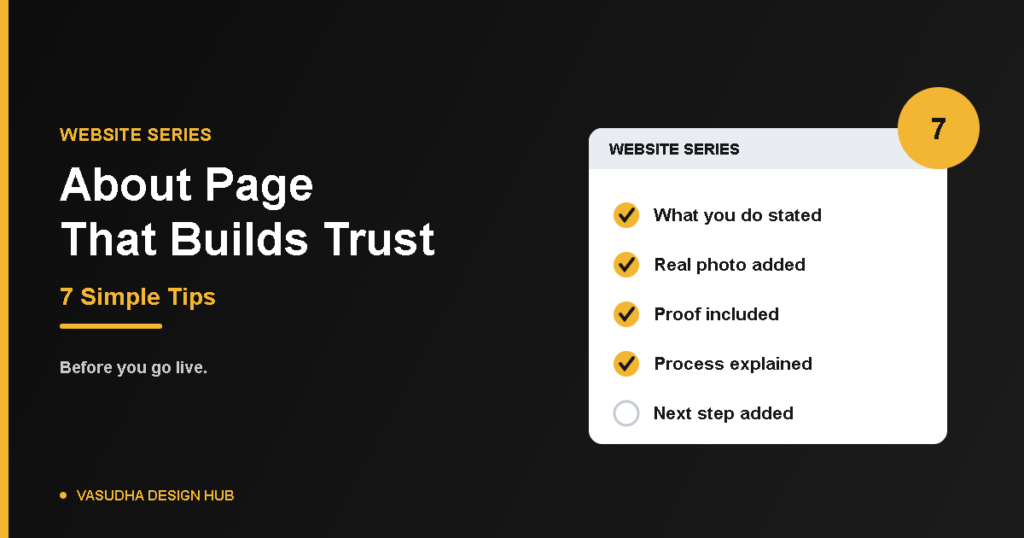
How to Write an About Page: 7 Tips
1. Open with what you do and who for
Start with one clear sentence, such as “We design websites for small businesses in Nashik.” Don’t open with the year you were founded. Visitors came to find out if you can help them.
2. Tell your story briefly
Say why you started the business and what you care about, in a few honest sentences. A short, real reason, such as a problem you noticed in your own work, is more convincing than a paragraph of general claims.
3. Show the real people
Add a genuine photo of yourself or your team instead of stock images, one of the website mistakes that makes a business feel generic. Don’t invent team members, titles or credentials. Google’s guidance warns against fabricated author profiles, and customers can usually tell.
4. Give proof you can check
Mention things that are real and specific: years of experience, training or certifications, the number of projects you’ve handled, or client names with their permission. If you’re new, use your experience before the business, such as your previous work, your training or how you work. Never invent numbers.
5. Explain how you work
A short three-step process, such as “we listen, we plan, we deliver,” shows customers what to expect. Uncertainty puts people off more than price does.
6. Add the practical details
Include your location, areas served, hours and contact details, and keep them identical to your Google profile. Our guide to set up a Google Business Profile explains why consistent details matter.
7. End with a clear next step
Finish with one action, such as “Get a free quote” or “Book a call,” as a button. A visitor who has just decided to trust you should never have to hunt for what to do next.
A Simple Structure to Copy
Here’s a layout you can adapt:
- Headline: what you do and who for
- Opening paragraph: the problem you solve
- Your story: two or three honest sentences
- Photo and names: you and your team
- Proof: experience, results or credentials that are real
- How we work: three short steps
- Contact and next step: details and a button
For example, suppose a small bakery in Nashik writes: “We bake custom cakes for birthdays and weddings in Nashik, using recipes the family has used for years. Order on WhatsApp and we’ll confirm the design within a day.” That one short paragraph says what they do, where, and what to do next.
Common Mistakes
Writing only about the company’s history, using stock photos, claiming to be “the best” without proof, leaving out contact details and forgetting to update the page are the usual problems. Review your about page whenever your services, team or location change.
Quick Questions
How long should an about page be?
Three to five hundred words is enough for most small businesses.
Should I include a photo of myself?
Yes, a real photo builds trust. Avoid stock images.
Do I need an about page if I work alone?
Yes. A solo business needs it even more, because customers want to know who they’re dealing with.
The Bottom Line
A good about page answers who you are, what you do for customers like them, why they can believe you, and what to do next. Keep it honest, specific and up to date. When you’re ready to put the whole site together, see our guide to build a small business website, and if you’d like help with the writing or the design, our website design services are a good place to start.